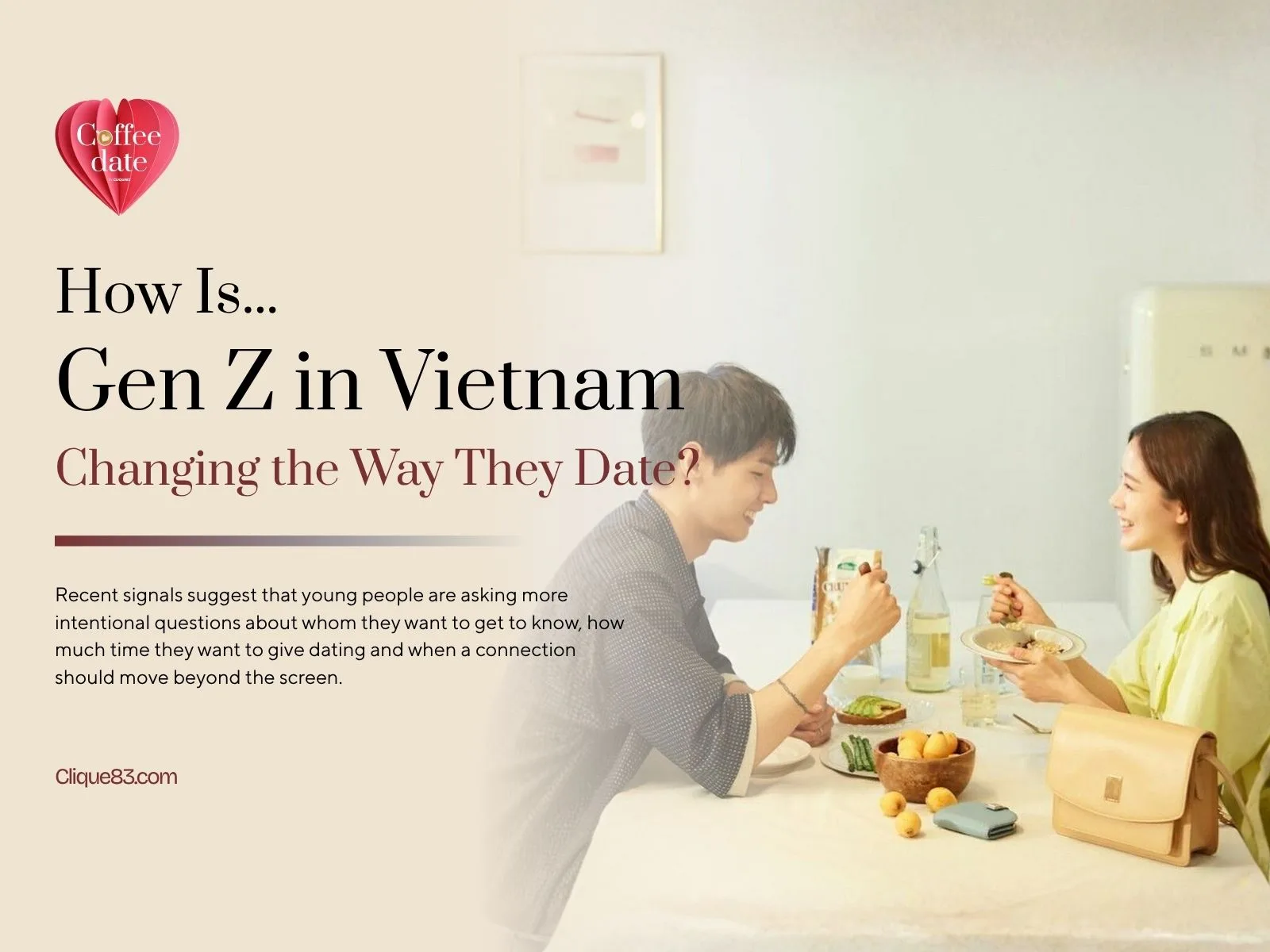
Gen Z in Vietnam has grown up in a world where a new connection can begin on a dating app, through social media or with an introduction from a friend. Technology has created more ways to meet someone new, while also giving people more choice over how they want that first connection to begin.
What is changing is not simply a move from online dating to offline dating. Recent signals suggest that young people are asking more intentional questions about whom they want to get to know, how much time they want to give dating and when a connection should move beyond the screen.
The dating landscape is becoming broader as a result. Dating apps remain one option, while shared-interest communities, singles events and one-on-one introductions are creating more ways for two people to enter each other’s lives. In this article, Clique83 explores how those choices are shaping the way Gen Z in Vietnam approaches dating.
What Is Gen Z in Vietnam Looking for When Dating?
For many Gen Z daters, a first date begins with wanting to understand the person in front of them before deciding what the connection needs to become. There is often more room for the relationship to develop before either person feels the need to define where it is going.
Vietnam’s dating landscape has reflected this variety for some time. Decision Lab’s Dating Apps in Vietnam research found that almost half of surveyed dating app users used the platforms to make friends, while dating and long-term relationships also appeared as other motivations. The data comes from 2022 and does not represent Gen Z today specifically, yet it shows that Vietnamese users were already entering dating apps with different expectations rather than one single destination in mind.
A first date can therefore simply be time for two people to talk and notice how they feel in each other’s company. Comfort, curiosity and the desire to continue often become clearer through the way the conversation unfolds.
Afterwards, a more useful question may be:
Do I want to know more about this person?
When the outcome does not have to be decided before the experience begins, dating has more room for curiosity. Two people can explore a connection before deciding what they want to call it.
Gen Z Wants More Context About Someone Before Meeting
A profile gives you the basics about a person. Deciding to spend an evening meeting them often requires a little more context.
Photos, occupation and interests help you form an initial picture. What someone cares about, how they approach relationships or the story behind one of their interests can reveal much more about the person behind the profile.
A similar signal appears in international dating research. Bumble’s Global Dating Trends 2025 report found that 49% of surveyed single Gen Z respondents viewed sharing excitement around something they love as a form of intimacy. Bumble also highlighted the rise of micro-communities built around shared interests, such as book clubs and running clubs, as spaces where younger people are forming connections. The findings are global and therefore work better as a broader behavioural signal than as direct evidence about Gen Z in Vietnam.
From that perspective, a useful profile goes beyond answering what someone does. It gives you a glimpse of the person behind those basic details. Work and hobbies create a starting point, while stories and the things someone genuinely cares about tend to spark deeper curiosity.
An introduction becomes worth exploring when something makes you want to hear more, ask another question or imagine what a conversation with that person might feel like in real life. That curiosity can become a very natural reason for a meeting to begin.
Gen Z Wants to Spend Less Time Searching for Someone to Date
Dating has always required time. What feels more noticeable now is how carefully younger people are thinking about which part of that time is actually worth giving to the process.
A dating app journey often begins long before the date itself. You open the app, browse several profiles, start conversations and keep them going long enough for both people to decide if they want to meet. For someone who enjoys exploring independently, that process can be part of the fun. For someone else, it becomes another thing to maintain within an already full life.
A broader signal about the relationship between Gen Z in Vietnam and digital life appeared in Decision Lab’s The Connected Consumer Q3 2023. The average Gen Z respondent in the study used five social media platforms, while 76% said they wanted to leave at least one. Decision Lab connected that desire with taking back greater control over time and mental space from digital environments. The study was not specifically about dating, yet it offers useful context for a generation that is deeply connected online while also becoming more conscious of how much attention digital life receives.
Dating has to compete with work, hobbies and the parts of life young people want to keep for themselves.
Tuổi Trẻ Online also discussed dating app fatigue in a 2024 article about Gen Z and dating apps, with examples centred around the energy spent swiping, maintaining conversations and waiting for a connection to turn into a real meeting. Most of the cases referenced came from international contexts, so the article is more useful as a sign of wider dating fatigue than as evidence specific to Vietnam.
The point is therefore not that young people want to spend less time on relationships. They may simply want to spend less time searching so they can give more attention to the connections they genuinely want to explore.
Offline Dating Helps Gen Z Understand a Connection More Clearly
Someone can feel fascinating through messages and completely different once they are sitting across from you. Meeting in person turns many of the things that remain vague on a screen into something you can actually experience.
You hear the way they tell a story and notice how naturally the conversation moves. More importantly, you begin to understand yourself within the meeting: if you want to share more, if you feel curious about what comes next or if the conversation has simply been a pleasant experience that feels complete.
In Vietnam, offline dating formats have also become more visible in the media. In Đi tìm “nửa kia” ở thời đại AI, published in March 2026, Tuổi Trẻ described the experiences of young adults joining face-to-face dating formats in Ho Chi Minh City and Hanoi, including Clique83. One participant shared that meeting in person helped two people understand each other more quickly and reduced some of the hesitation that can appear when communication remains online. The article also documented formats ranging from group gatherings to one-on-one Coffee Dates, showing that offline dating in Vietnam is already taking several different forms.
The value of a real meeting does not depend on it becoming a relationship.
You may leave wanting to see that person again. You may also realise that the two of you had an enjoyable conversation and that the story feels complete there.
Both outcomes offer something difficult to replace through profile-based guessing:
clarity from your own experience.
Communities and Events Are Giving Gen Z More Ways to Meet New People
Meeting someone new no longer has to come down to either approaching a stranger or downloading a dating app. Social settings with an existing context are creating more natural starting points for connection.
A class, running community, book club or singles event places people in the same environment before anyone has to worry about the question, “How do I start talking to them?” The shared setting already gives the conversation somewhere to begin.
The growth of micro-communities mentioned in Bumble’s dating trends report supports this direction on an international level. Interests are becoming more than profile details; they are also creating spaces where younger people meet through activities they already wanted to join.
Even dating apps are bringing more social elements into the experience. Tinder launched Double Date in 2025, allowing two friends to connect with another pair. During international testing, nearly 90% of profiles using the feature belonged to users under 29. Tinder’s own data does not represent Gen Z in Vietnam, although the level of participation among younger users suggests that dating formats involving friends are attracting meaningful interest.
These options can be particularly helpful for someone who finds the pressure of an immediate one-on-one date too intense. Instead of placing all your attention on one stranger from the first minute, you can begin in a space where meeting people is already a natural part of what everyone came to do.
Gen Z Wants More Control Over How They Date
Having control in dating does not necessarily mean doing every part of the search yourself.
Dating apps give you direct control over discovery. You choose which profiles to view, decide whom you want to talk to and manage the journey towards a meeting yourself.
A one-on-one introduction experience distributes that control differently. The search happens with support in the background, while you focus on the decisions that directly belong to you: what information you want to share and if you want to meet the person being introduced.
Both approaches preserve choice. The difference lies in which parts of the journey you want to spend your own time managing.
Looking at dating this way also separates the idea of receiving support from the idea of someone else deciding for you.
A system can prepare an introduction. You still decide if you want to know more or stop there. A team can help turn a mutual decision into a confirmed date. Your feelings about the person still belong entirely to the two people in the meeting.
Control therefore lives in the decision itself, rather than in the number of steps you personally complete before the date.
Dating Apps and Offline Dating Are Shaping Gen Z Connection Together
Dating apps and offline dating meet different needs within the journey of meeting someone new.
Dating apps create a broad space where you can explore several profiles and begin connecting whenever you want. That flexibility remains valuable for people who enjoy taking the lead in their search or prefer seeing more options before deciding.
Offline formats move more of the attention towards the real-life experience. A shared-interest community gives two people a natural reason to talk. An Event Mixer opens several conversations within one evening. A one-on-one introduction brings the focus back to one person at a time.
The current dating picture in Vietnam therefore makes more sense as several ways of dating existing alongside one another, rather than one new format replacing an older one.
Decision Lab found that 56% of surveyed single Vietnamese people used at least one dating app in 2022, showing that online dating already had a clear place in the way people met. By 2026, Tuổi Trẻ’s reporting on additional face-to-face dating formats suggests that singles now have more options alongside that path. Two sources from different periods are not enough to claim a market-wide transition, although together they show a dating journey that is becoming more varied.
The question does not necessarily need to be:
“Is online or offline dating better?”
A more useful question is:
“Which way of beginning feels more natural to you when you are getting to know someone?”
What Dating Options Does Clique83 Offer Gen Z in Vietnam?
Clique83 creates real-life dating experiences for people who want more opportunities to connect without managing every step of the search on their own.
With Coffee Date by Clique83, you begin by sharing more about yourself and what you are looking for through your profile and questionnaire.
When you receive an introduction, you see more than a few basic details. The Match Letter offers additional context around the person’s story, what matters to them and the common ground behind the introduction, giving you more information before you decide for yourself if you want to meet them in real life.
When both people want to meet, the Clique83 team helps coordinate the time and location. The rest belongs to the two people sitting in the conversation.
With an Event Mixer - Thử Vị Yêu by Clique83, the beginning is more social. You meet several people within the same space, with activities designed to make starting conversations easier. Afterwards, you decide for yourself whom you feel curious about continuing to know.
The two formats create different beginnings. Coffee Date focuses your attention on one private introduction, while Event Mixer gives you space to explore several real-life conversations.
Clique83 does not decide where a connection needs to go. The role of the system and the team is to create more opportunities for a real meeting to begin.
The Way Gen Z in Vietnam Dates Will Keep Evolving
Gen Z in Vietnam remains closely connected to technology, so online dating will continue to be a natural part of how this generation meets new people. The screen, however, is no longer the only place where a dating journey can begin.
Young people now have more choice over how they want to explore connection: browsing several profiles or focusing on one introduction, beginning in a community or sitting down for a private one-on-one meeting.
Perhaps the most meaningful change is that more of that choice is returning to the person dating.
You choose how you want to begin. You decide whom you want to know more about.
And in the end, technology or any form of support can only bring two people closer to the meeting.
The real story still begins when two people sit down in front of each other.
FAQs
Why Is Gen Z Becoming More Interested in Offline Dating?
Meeting in person helps you experience things that profiles and messages rarely communicate completely, especially the way the conversation flows and how you feel around the other person. Experiences documented by Tuổi Trẻ at face-to-face dating formats in Vietnam in 2026 also suggest that younger people are using offline dating as another way to create opportunities for genuine meetings.
How Can Gen Z Meet New People Without Dating Apps?
You can widen your opportunities through shared-interest communities, introductions from friends, Event Mixers or one-on-one dating experiences such as Coffee Date. The common thread is having a clearer context where a real-life conversation can begin.
References
An Vi, & Ngọc Sang. (2026, March 20). Đi tìm “nửa kia” ở thời đại AI. Tuổi Trẻ Online.
Bình Minh. (2024, February 19). Gen Z từ bỏ ứng dụng hẹn hò vì tốn thời gian. Tuổi Trẻ Online.
Bumble. (2024). Bumble’s 2025 global dating trends.
Decision Lab. (2022). This Valentine’s Day, Vietnamese are swiping right for love.
Do, P. (2023). Gen Z wants to disconnect. Decision Lab.
Tinder. (2025, June 17). Tinder launches “Double Date”: The new way to make connections with your bestie. Tinder Newsroom.