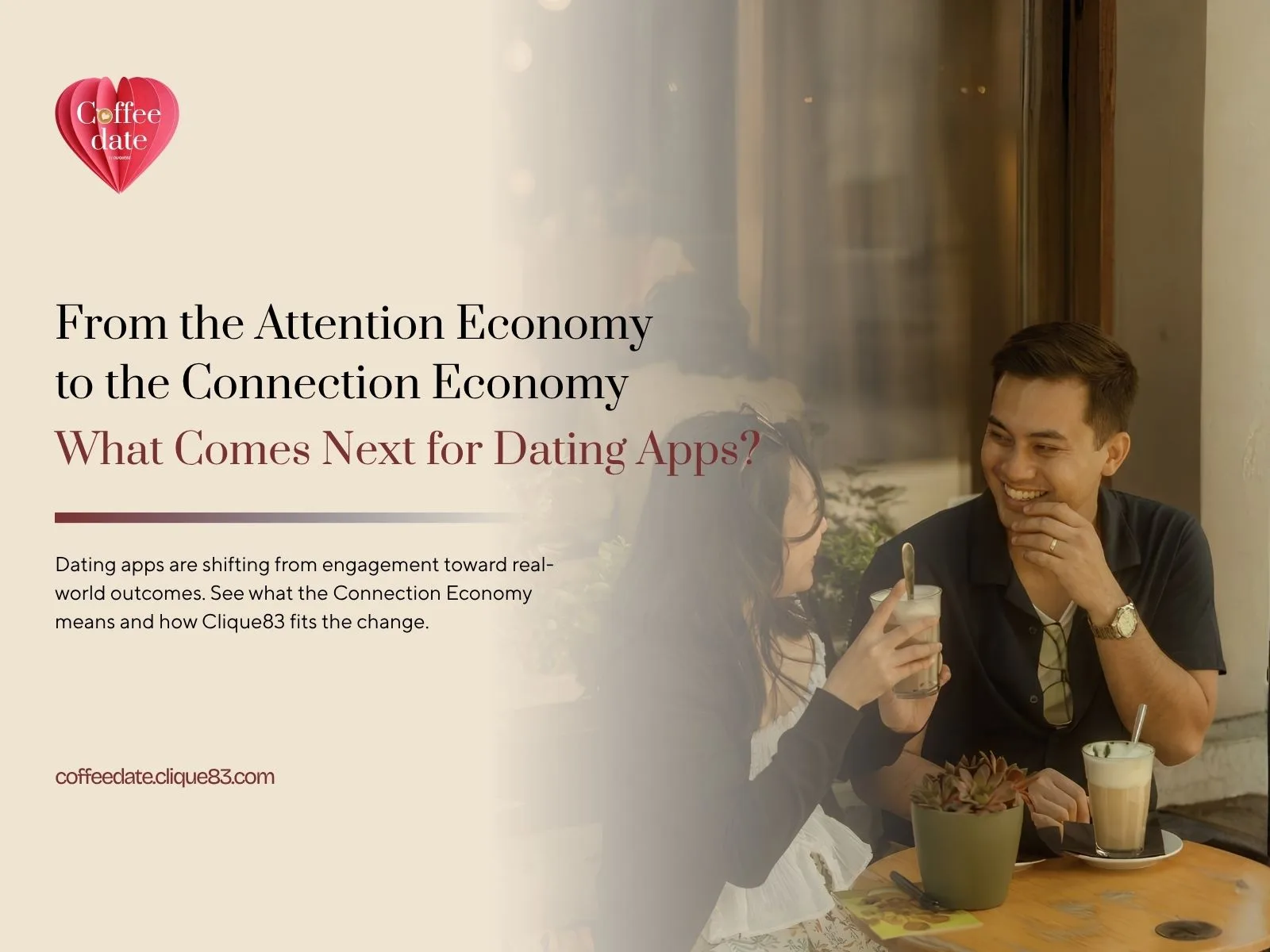
Dating apps made meeting new people highly scalable. The next question is what they should scale: more activity inside the product, or more meaningful connections outside it.
At Clique83, we are building around the second idea. Founded in Vietnam by Han Lam and Thuy Doanova, we designed our Coffee Date experience to use technology as a bridge to real-life connection. Our system introduces one person worth considering at a time, then gives both people a clear path toward an offline date.
That points to a broader way of thinking about the future of dating: a move from the Attention Economy, where value is closely tied to continued digital activity, toward a Connection Economy, where technology succeeds when it helps people build a connection that continues beyond the product itself.
What does the Connection Economy mean for dating apps?
The Connection Economy puts the value of a dating product in the connection it helps create, rather than the amount of time people remain inside the product.
The term is useful as a strategic lens rather than a formal dating industry category.
Attention still matters. Dating products need active users and enough marketplace activity to create opportunities. The difference is what that activity is designed to achieve.
An attention-oriented dating model focuses on continued activity inside the product:
Primary value: continued digital activity
Typical journey: discover → swipe → match → chat → repeat
Useful signals: DAU (Daily Active Users), MAU (Monthly Active Users), retention and messages
Role of AI: improve discovery and engagement
Desired outcome: continued product use
A connection-oriented model focuses on helping a connection progress beyond the product:
Primary value: progress toward a meaningful connection
Typical journey: understand → introduce → decide → meet
Useful signals: mutual interest, match-to-meet conversion, attendance and post-date signals
Role of AI: reduce search friction and support better introductions
Desired outcome: a connection people want to continue in real life
The distinction matters because a match is still an intermediate event. A dating product creates its clearest user value when something meaningful happens because of that match.
In some successful cases, that value eventually makes the product less necessary. Someone who meets a person they want to keep seeing has a reason to spend less time dating, pause their account or leave the product altogether.
Why is engagement alone an incomplete measure of dating product value?
Engagement shows how actively people use a dating app, but it does not show how effectively the product helps them move toward a meaningful connection.
Dating products have a unique dynamic: strong product outcomes and continued usage do not always move in the same direction. Someone who finds a person they want to keep seeing has less reason to keep searching.
The reason behind lower usage therefore matters. Leaving because the experience failed is very different from stepping away because the product helped create a connection worth continuing.
Retention shows who remains active. Connection outcomes show whether the product is helping people reach the reason they joined in the first place.
The industry is starting to reflect that distinction in product strategy. Match Group entered 2026 saying its transformation was focused around user outcomes. CEO Spencer Rascoff has also described technology as a tool for helping people create real connections and move into the real world, rather than replacing human relationships.
The bigger question for dating apps is therefore not only how much engagement they create, but where that engagement leads.
Dating platforms are starting to move closer to real-world outcomes
Major dating companies are adding products designed to shorten the distance between digital discovery and meeting in person.
Tinder launched its Events feature in March 2026, then expanded it across the U.S. and Europe. By September, the company planned to have Events available in 26 cities. During the Los Angeles pilot, Match Group reported that 71% of eligible active Tinder users aged 18–24 interacted with the Events tab.
Bumble is making a similar product shift. In its Q2 2026 results, CEO Whitney Wolfe Herd described the company's roadmap as helping members connect more intuitively and move more quickly toward in-person dates, alongside changes to matching, conversation and real-life experiences.
There is a broader cultural signal behind these product decisions as well. Eventbrite's 2026 Social Study found that 74% of surveyed 18-to-35-year-olds considered in-person experiences more important than digital ones, while 79% planned to attend more events during 2026.
None of these signals mean digital dating is disappearing.
They suggest something more important: the screen is increasingly becoming the starting layer of connection rather than the final destination.
Dating Products Create More Value When Connections Keep Moving Forward
A connection-first dating product creates value by helping people move from discovery toward a meaningful next step, rather than simply increasing the volume of profiles, matches or conversations.
More choice expands the pool. More matches increase activity. Neither tells us how easily a connection progresses after two people show interest.
The more useful product question is where people stop moving forward.
If introductions rarely lead to mutual interest, the matching experience needs attention. If mutual interest rarely becomes a confirmed date, friction exists later in the journey. If confirmed dates regularly fail to happen, the problem sits closer to coordination, trust or commitment.
Looking at progression in this way helps a dating product identify where value is being created and where it is being lost.
Useful signals include:
the share of introductions that create mutual interest;
the share of mutual decisions that reach a confirmed meeting;
attendance once a date is arranged;
what users choose to do after meeting.
These signals do not replace engagement data. They add another layer: engagement shows that people are active, while progression shows that the product is helping the connection move somewhere.
The product is therefore a bridge in the journey, rather than the place where the connection is meant to stay.
Once connection becomes the outcome, we also need a different way to create value around it.
And When Connections Move Forward, Business Value Moves With Them
When a dating product helps connections progress, new forms of value emerge around that journey.
That changes where business value sits. Revenue can come from access to better introductions, premium support, coordinated dates and real-world experiences that help people move forward with greater intention.
At Clique83, that logic already appears across our services. Coffee Date helps people move from an introduction toward an offline meeting, while Coffee Date Premium and Event Mixer create additional ways to support more guided and real-world connection experiences.
The business therefore grows by creating more opportunities for meaningful connection and making that journey easier to complete.
In the Connection Economy, the product does not need to become the destination. It creates value by helping people reach one.
Clique83 is building around the real-life date as a product outcome
At Clique83, we start from a simple product thesis: matching creates possibility, while meeting gives two people the chance to discover if they want the connection to continue.
Our Coffee Date experience is built around one introduction at a time. Users do not browse an endless profile feed. We use AI to support matching based on the information people share with us, while profile review and human support help the experience move toward a real meeting.
The introduction arrives through a Match Letter. Each person decides independently if they want to meet. Only when both say yes does Coffee Date move toward arranging the time and partner venue for the offline date. There is no built-in texting stage to prolong the process.
The product design therefore creates a different funnel:
Profile → introduction → mutual decision → confirmed date → real-life interaction
rather than treating the match itself as the end result.
We are not building Coffee Date to become the place where a connection lives. We are building it to help that connection begin, then become less central when two people decide they want to continue it themselves.
Our current company data reports a 22,000+ waitlist, 500+ Coffee Dates arranged, a 73.8% phone-exchange rate after meetings and a 0.1% no-show rate.
These figures give us a clearer view of behavior beyond the match: people choosing to meet, showing up and deciding whether they want to continue the connection after the date.
A person stepping away because they want to focus on someone they met through Coffee Date represents a very different outcome from someone leaving because the experience created no value. The reason behind the exit matters.
That is what the Connection Economy means in product terms for us: technology helps create the introduction and the real-life meeting, then gives the human connection room to take over.
See how we are building for real-life connection
The Connection Economy is more than a thesis for us. It shapes the experiences we build.
From Coffee Date and Event Mixer to Coffee Date Premium and The Love Library, our services create different paths toward the same outcome: helping people build connection beyond the screen.
FAQs
What is the Attention Economy in dating apps?
The Attention Economy describes digital products where continued activity, engagement and user attention are important sources of business value. In dating, metrics such as DAU, MAU, retention, matches and conversations can reveal marketplace health, although they do not fully show if users are reaching meaningful connections.
What is the Connection Economy in dating?
The Connection Economy describes a product model where technology creates value by helping people form connections that continue beyond the product itself. In dating, success therefore goes beyond keeping people active inside an app: the product helps them move from discovery toward a real-life connection they want to continue.
Are dating apps moving toward offline dating?
Several major platforms are adding stronger real-life components. Tinder expanded its Events product in 2026, while Bumble has publicly said its product roadmap aims to help members move more quickly toward in-person dates. Clique83 was built around this direction from the start, with Coffee Date designed to help digital introductions progress toward real-life meetings.
These developments suggest that offline dating and real-world connection are becoming a more important part of how dating products create value.
How is Coffee Date by Clique83 different from a traditional dating app?
Coffee Date by Clique83 uses technology to support a path toward an offline meeting. Users receive one introduction at a time rather than browsing an endless feed. When both people want to meet, the Coffee Date experience supports the scheduling and venue arrangement for the real-life date.
What metrics matter for a connection-first dating app?
Useful metrics can include match-to-meet conversion, confirmed-date attendance, no-show rates, post-date continuation signals and the economics of producing each successful real-world interaction. Engagement metrics still matter because the marketplace needs sufficient activity and density, though they tell only part of the product story.