
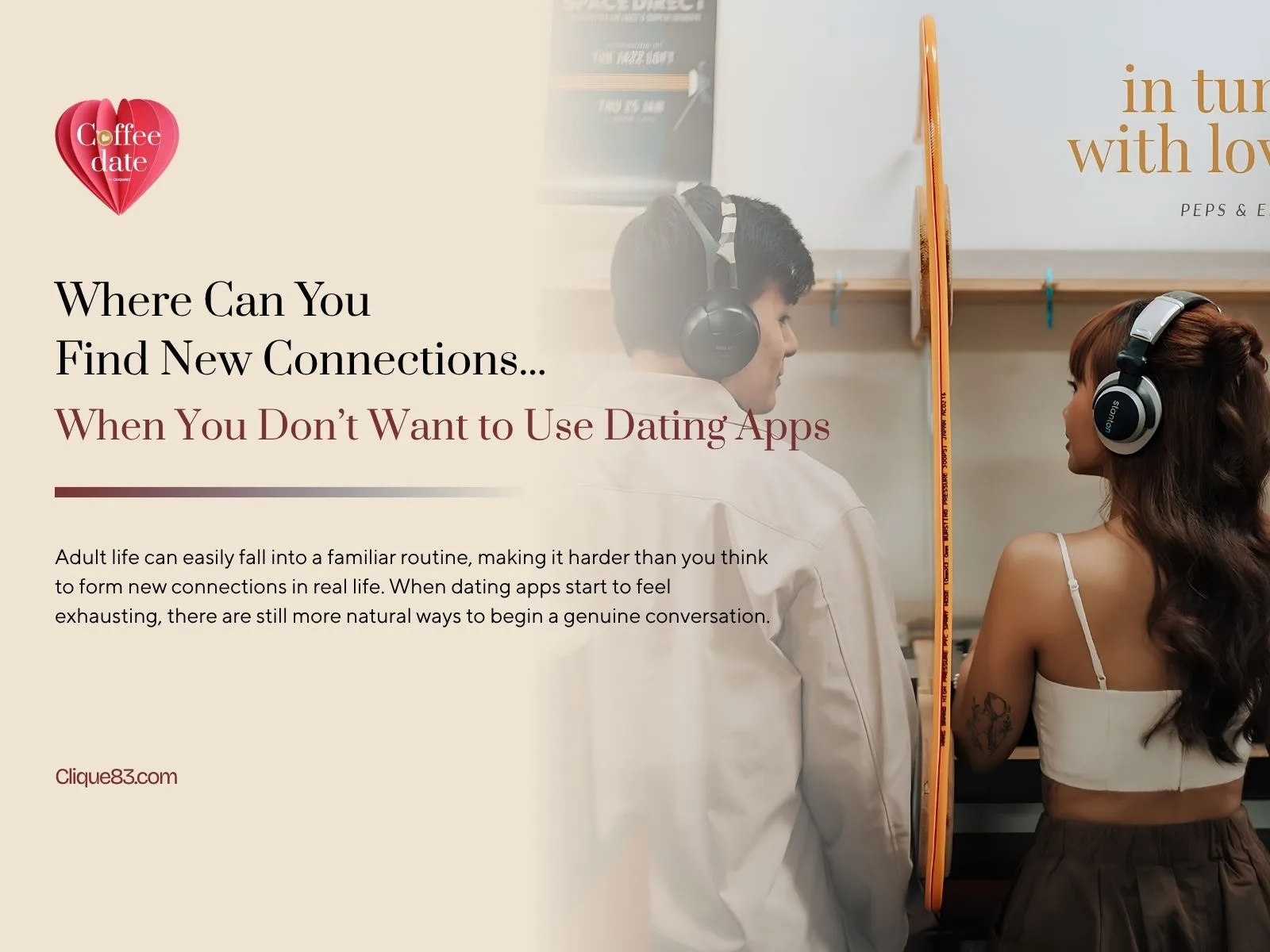
Adult life can easily settle into a familiar cycle: going to work, returning home and preparing to do it all again the next day. Weekends may still revolve around the same friends, familiar places and stories you have already heard many times. The city is always crowded, yet the opportunity to genuinely meet someone new can feel surprisingly rare.
Dating apps once created the impression that a few swipes could lead to a conversation worth waiting for. Over time, looking through profiles, waiting for replies and repeatedly starting again with someone new can become another source of exhaustion. You still want connection; you simply no longer want to spend your energy beginning in the same way.
The wish to meet someone in real life is therefore about more than finding love. You may be looking for a fresh conversation, a wider social circle or someone whose attention makes you feel heard in a way you have not experienced for some time.
So where can you meet new people when you do not want to use dating apps, and how can a conversation begin? This guide from Clique83 explores real-life settings in Vietnam where meeting someone new can feel more natural and where two people have a genuine opportunity to discover each other.
A Busy Place Is Not Always an Easy Place to Meet Someone New
A crowded café can still be filled with people working behind their own screens. At the gym, most people are focused on their workout, while someone visiting a bookshop or coworking space alone may have little interest in being approached.
A location only brings two people physically closer. The context creates the opportunity for a conversation to begin.
Settings that naturally support connection usually offer a shared activity, encourage interaction, create opportunities to meet again and establish clear social boundaries. You understand why you are there, while the people around you also recognise that talking to someone new is part of the experience.
From Clique83’s experience arranging face-to-face introductions, many people are perfectly capable of holding a conversation. What often holds them back is the fear of interrupting someone or the uncertainty of knowing how to begin.
Instead of only asking, “Will there be many single people there?” ask yourself:
“Does this setting give me a natural reason to talk to someone new?”
From introductions through mutual friends to communities built around shared activities, the following options can help you widen your social circle and create more opportunities for real-life connection.
1. Meet New People Through Friends and Extended Social Circles
Friends remain one of the most natural ways to meet someone new in Vietnam. A dinner that brings different groups together, a birthday celebration, a weekend trip or a shared activity can expand your social circle without making the experience feel like a date from the beginning.
You also do not need to ask your friends to “find you a partner.” That request can place unnecessary expectations on the person making the introduction and on the person being introduced.
A lighter conversation leaves more room for something to happen naturally:
“I’d like to meet more new people lately. Let me know the next time everyone brings different friends along.”
When you meet through someone you both know, the conversation already has a natural starting point. You can talk about your mutual friend, how everyone met or what is happening around you, making the interaction feel less abrupt than approaching a complete stranger.
Research into the “friends-first” pathway also suggests that many romantic relationships begin as friendships, even though this path has historically received less attention in dating research.
An introduction through friends is still only a beginning. Someone who knows you understands one part of your personality, yet they may not fully understand how you connect emotionally or what you value most in a relationship. The real feeling belongs to the two people involved once they have spent time together.
2. Join a Community You Can Return to Regularly
Communities with recurring activities often create more realistic opportunities for connection than one-time encounters. You have a reason to show up, share an experience with other people and see familiar faces again at future gatherings.
Research by Jeffrey Hall found that the amount of time people spend together is associated with the development of friendship. Time spent in shared leisure activities was also a stronger predictor of closeness than simply being present together at work or school.
You do not need to choose an activity based on its potential to help you meet a partner. Choose an experience that would still feel meaningful even when you do not meet anyone you want to know more deeply.
Community-Based Sports Activities
Running clubs, dance classes, badminton groups, indoor climbing communities and walking groups create a different kind of interaction from exercising alone.
A conversation can begin with something already happening around you, such as asking about a route, exchanging training experiences or taking part in a group activity. When you see each other again the following week, you already have a previous conversation to continue.
The key lies in the sense of community. A busy gym does not automatically create opportunities to talk, while a group with a shared schedule and coordinated activities naturally creates more moments of interaction.
Multi-Session Classes and Workshops
Pottery, drawing, cooking and photography classes bring people into the same experience. You do not need to create a particularly clever opening line because the subject of the class already gives everyone something to discuss.
Courses held over several sessions also give you time to observe how someone communicates, responds and treats the people around them. Your impression develops through several small moments rather than relying entirely on a few minutes of initial conversation.
Prioritise classes that include hands-on activities or group discussion. A workshop where one person speaks and everyone else only listens creates far fewer opportunities for participants to connect.
Language Exchanges and Cultural Communities
Language exchanges are a popular option in Ho Chi Minh City, particularly among people who want to practise another language and meet individuals from different cultural backgrounds.
Event listings in the city regularly include Vietnamese–English exchanges, board-game gatherings, craft workshops and other community activities. Some language groups meet weekly, giving participants opportunities to return instead of seeing each other only once.
Language activities also provide a clear reason to ask questions and share personal stories. Begin with a genuine interest in learning and cultural exchange, then allow any deeper connection to develop at its own pace.
Volunteering and Community Projects
Volunteer programmes help you move beyond your professional circle and meet people who care about the same social issue.
These activities are not spaces to enter with the primary goal of finding a romantic partner. Their real value comes from the work you want to contribute and the experience of supporting a community. As you prepare, travel and solve practical tasks together, you naturally learn how other people cooperate and care for those around them.
A connection that grows in this setting begins through a shared experience rather than the pressure to impress someone within a short meeting.
3. Look for Events Designed Around Interaction
An event with many attendees does not always help you expand your social circle. A conference with hundreds of people can still end with you speaking only to the person who came with you.
When choosing a workshop, talk, professional event or social gathering, look closely at how the programme is structured. Useful signs include small discussion tables, group activities, introductions between participants and dedicated time for conversation.
An event that naturally supports connection usually answers questions such as:
Do the participants share an interest in a specific subject?
Does the programme create reasons for people to interact?
Is the group size small enough for conversations to continue beyond a quick introduction?
You can also take a more intentional and relaxed approach. Instead of trying to speak with as many people as possible, give your attention to one or two conversations with greater depth. Ask why the person attended, which part they enjoyed or what experience they have with the shared topic.
Your goal does not need to be leaving the event with a long list of phone numbers. One conversation that both people want to continue is enough for your familiar circle to begin expanding.
4. Cafés, Bookshops and Gyms Are Only Locations
Familiar places can still lead to new encounters, although the real opportunity usually comes from the activities happening within them.
A café becomes a social setting when it hosts board-game nights, workshops, language groups or community events. A bookshop creates a reason to talk through reading clubs, author events or discussions around a shared subject.
In the same way, a gym becomes more interactive when you join a group class or training community. A coworking space also feels more open during member gatherings than on days when everyone is working independently.
You still need to pay attention to the other person’s signals. Someone who removes their headphones, responds warmly and continues asking questions is showing a different level of openness from someone who gives a short answer and immediately returns to what they were doing.
Begin with the shared context and allow the other person to end the exchange comfortably. The respect you show during those first few minutes also shapes how both of you experience each other.
5. Choose Meeting Experiences With Clearer Intentions
Communities and familiar settings help you widen your circle gradually. Organised meeting experiences become more useful when you want to know from the beginning that the people present are also open to conversation and exploring a new connection.
In March 2026, Tuổi Trẻ News reported that busy young adults in Ho Chi Minh City and Hanoi were attending face-to-face dating events because their work schedules were demanding and their social circles mainly involved colleagues. The article also mentioned Clique83’s group events and private one-on-one coffee meetings for people who preferred a quieter setting.
You might choose a group event when you want to meet several people in one evening and would appreciate a host helping conversations begin. A one-on-one dating experience offers a slower rhythm, allowing two people to focus on each other after both have agreed to meet.
The main difference is the level of intention. You do not need to wonder if the person across from you is open to meeting someone new because conversation and introduction are already understood as part of the experience.
These formats still do not decide your feelings for you. Their value lies in creating a clearer starting point so your time and emotional energy can be directed towards a real meeting.
Choose a Setting Based on How You Prefer to Connect
There is no single place to meet new people that feels right for everyone. One person may leave a lively event feeling energised, while another only begins opening up during a private conversation.
When you prefer getting to know people gradually, choose a community with recurring activities. Seeing the same people again allows the conversation to continue without forcing you to decide too soon.
When an activity helps you feel more comfortable starting a conversation, consider group sports, classes or interactive workshops.
When you want to experience several conversations, look for an event mixer with a host and a clear structure that helps everyone understand how to begin.
When you prefer focusing on one person at a time, consider a personal introduction or a private one-on-one meeting.
The best place to try first is one where you can show up naturally instead of forcing yourself to perform a more outgoing version of who you are.
Begin With One Small Change in Your Routine
Wanting to meet new people rarely creates meaningful change when your routine still revolves around the same places and familiar faces.
You do not need to fill your calendar with events. Choose one practical action that you can maintain:
Join an activity that takes place regularly.
Accept an invitation you would usually decline.
Tell your friends that you want to widen your social circle.
Try a guided experience designed to help people meet.
After each experience, avoid measuring its value only by whom you met. Pay attention to how you felt: Did you feel comfortable talking? Did the setting help you express yourself naturally? Would you want to return?
Meeting people without dating apps is not about waiting for a chance encounter. You are still being proactive by creating more places where you can show up, be known and speak with people beyond your everyday circle.
Each meeting does not need to become a relationship. It can simply be the first step towards allowing your familiar world to include one more person.
Explore Real-Life Ways to Connect With Clique83
Everyone enters the journey towards connection at a different pace. Some people want to meet several people during one evening, others prefer giving their attention to a private conversation, while some want deeper guidance before entering a relationship.
Clique83 offers several ways to meet and explore love in real life: Event Mixer, Coffee Date and The Love Library. Each experience offers a different beginning, from conversations in a group setting to a private one-on-one introduction and a deeper journey towards understanding how you connect.
Explore Clique83’s experiences and choose the beginning that feels most natural for your pace.
FAQs
What If I Have Joined Many Activities but Still Have Not Met Anyone I Want to See Again?
The number of times you show up does not fully reflect how open or engaged you are within those experiences. Consider if you usually stay close to friends you already know, leave immediately after the programme or give other people very few opportunities to learn more about you.
Instead of registering for more events, try staying a little longer, returning to the same community or beginning one small conversation yourself. Familiarity often requires repeated encounters before two people feel comfortable enough to understand each other more deeply.
The fact that you have not met someone you want to continue with does not make your previous experiences meaningless. Each meeting still helps you understand which settings, conversational rhythms and ways of beginning allow you to feel most natural.
When Is It Worth Trying a Guided Introduction Service?
A guided service may be worth considering when your current social circle rarely changes, your schedule makes regular community activities difficult or you want to enter meetings with clearer intentions.
A supported introduction experience helps prepare the context, the beginning and the practical arrangements surrounding the meeting. Its value does not come from promising that every introduction will lead to romance; it comes from ensuring that you do not need to manage the entire search and coordination process alone.
You still decide whom you want to meet, how you feel after the conversation and if you want to continue learning about the person.
Which Activities Work Best When I Am Busy and Have Limited Time?
Prioritise experiences with a clear schedule that do not require you to attend every week. A short workshop, a monthly meeting event or a structured social gathering gives you a defined amount of time to meet new people without overwhelming your routine.
You can also accept an introduction through friends or choose a pre-arranged one-on-one meeting. Both options reduce the time spent searching for events, navigating large groups and maintaining several conversations at once.
Instead of joining many activities, give your time to one experience where you have enough energy to be genuinely present. A focused meeting often creates more opportunity to understand someone than repeatedly appearing in different places while already exhausted.
References
Decision Lab. (2022). This Valentine’s Day, Vietnamese are swiping right for love.
Decision Lab. (2022). Dating apps in Vietnam 2022 report.
Hall, J. A. (2019). How many hours does it take to make a friend? Journal of Social and Personal Relationships, 36(4), 1278–1296.
Stinson, D. A., Cameron, J. J., & Hoplock, L. B. (2022). The friends-to-lovers pathway to romance: Prevalent, preferred, and overlooked by science. Social Psychological and Personality Science, 13(2), 562–571.
Tuổi Trẻ News. (2026, March 21). In Vietnam, busy young people turn to offline dating events to find connection.