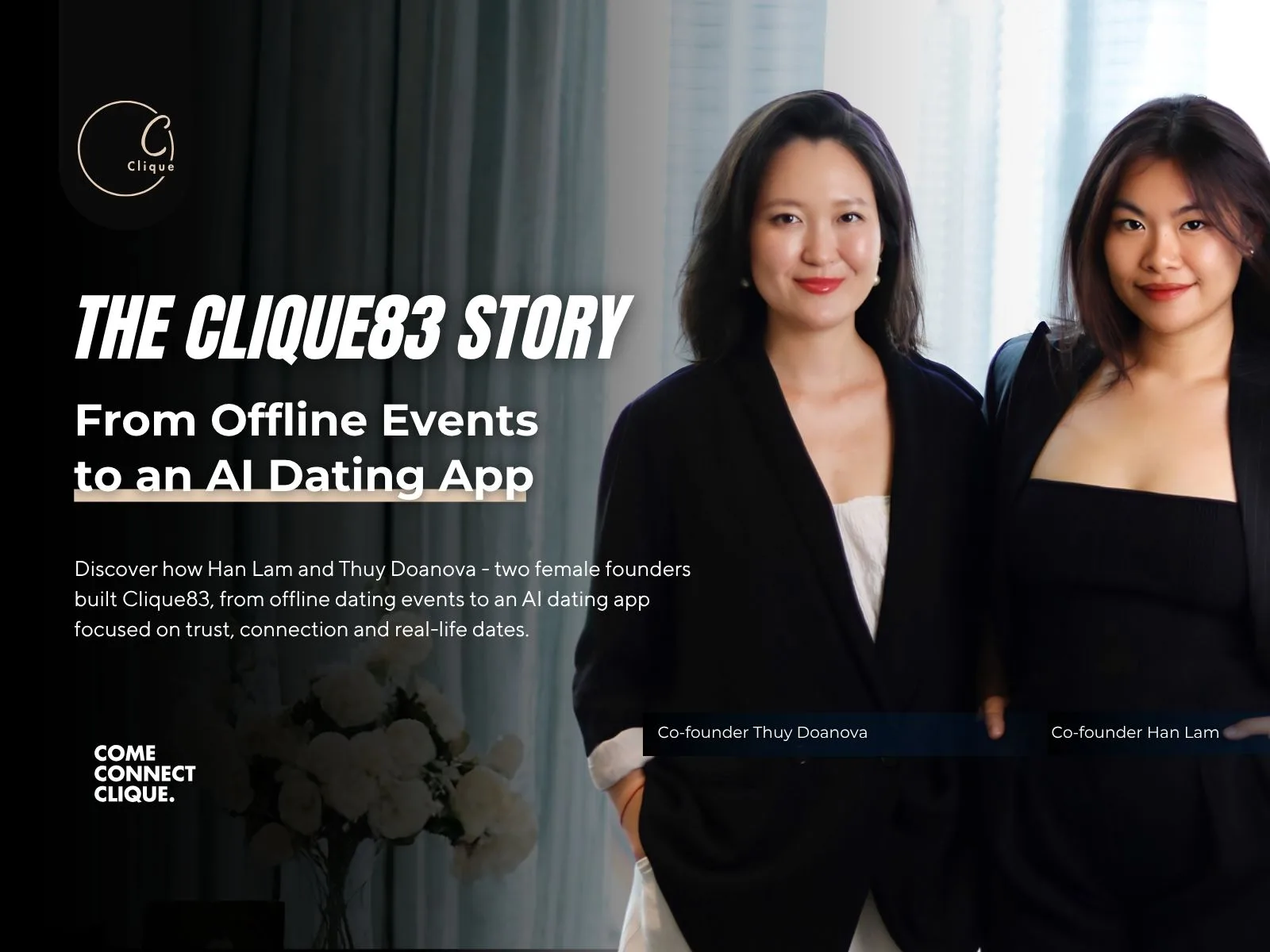
Before Clique83 became an AI dating app, it began with two women who understood how lonely modern dating could feel.
Han Lam and Thuy Doanova had built successful careers, lived internationally and met people from different walks of life. Yet both knew the distance between having an active life and finding someone with whom they could build a meaningful relationship.
Their personal experiences led to a simple belief: people needed better opportunities to connect in real life.
What began as offline dating events in Vietnam eventually grew into Coffee Date by Clique83, an AI-assisted dating app designed to turn introductions into actual meetings.
Along the way, we built something distinctive: a dating community where 75% of members are women, supported by an experience designed around personal choice, trust and genuine connection.
Our journey from offline events to AI technology has always been about one thing: helping people find their way back to each other.
Two women, two successful careers, and a shared experience of loneliness
Clique83 began with an experience both founders understood personally: achieving professional success while finding it increasingly difficult to build meaningful personal connections.
Loneliness does not necessarily mean being alone. People can have active social lives, supportive colleagues and fulfilling careers while still missing the emotional closeness they want in a relationship.
The World Health Organization's 2025 report on social connection estimated that one in six people worldwide experienced loneliness between 2014 and 2023. Although the finding does not specifically describe Vietnamese singles, it highlights how widely the need for meaningful connection is felt.
For Han Lam and Thuy Doanova, the problem was personal long before it became a business idea.
Thuy Doanova: Finding a different purpose beyond Google
Thuy Doanova, Co-Founder and COO of Clique83, spent more than two decades living in Europe after moving from Vietnam to the Czech Republic as a child.
She studied business in Germany and built an international career, eventually working as an Account Manager at Google's Dublin office.
From the outside, her career appeared to offer everything a young professional might want: financial stability, opportunities for growth and an established future in one of the world's leading technology companies.
Her personal life told a different story.
In a July 2025 interview with Kênh14, Thuy described how her professional achievements continued to grow while her personal relationships received less attention. She recalled returning home alone in the evenings and gradually realizing that another promotion or professional milestone was not what she wanted most.
She wanted to feel connected, understood and loved.
A three-month visit to Vietnam in 2023 became an important turning point.
Having spent most of her life in Europe, Thuy rediscovered a sense of closeness through everyday interactions with people in Vietnam. She felt connected to the country's culture and began thinking seriously about building a life there.
Her decision eventually took her away from Google and toward an entirely different career.
Rather than continuing to develop technology products for an established company, she wanted to help people create the kind of human connections she had been missing.
That personal motivation later became central to Clique83's understanding of its members: people bring emotional expectations into dating that a product needs to respect.
Han Lam: Building a career while losing space for personal connection
Han Lam, Co-Founder and CEO of Clique83, came to the same problem through a different path.
Born and raised in Ho Chi Minh City, Han studied and worked in the United States before returning to Vietnam to build her career.
Her professional experience covered several industries, including the food business. Before Clique83, she was also the CEO of O'smiles.
Building and operating businesses demanded significant time and attention. As responsibilities increased, opportunities to meet new people outside her existing social circle became increasingly limited.
In a November 2024 interview with VnExpress, Han explained that even when she met someone interesting, she did not necessarily know if that person was single or interested in a relationship.
The challenge involved more than finding time for another activity. Meeting new people required emotional energy, social confidence and the willingness to try again after disappointment.
Han also shared in a December 2024 ZNews feature that she had gone through a period of losing confidence in love itself.
Her experience shaped an important part of Clique83's philosophy.
People who struggle with dating are not necessarily unsuccessful, socially isolated or unwilling to form relationships. Their everyday lives can be full, while the opportunities to meet someone with genuine romantic intentions remain limited.
At Clique83, Han became responsible for turning that understanding into a product and operating model.
Her focus is on the details that make an unfamiliar experience feel clearer: how people enter the community, how they receive introductions and what support they receive before meeting someone new.
The same attention to trust that guided her previous business experience became part of the foundation of Clique83.
How did Han and Thuy come together to build Clique83?
Han and Thuy met through a startup incubator program in Vietnam, as described in their founder interview with Kênh14.
Both were exploring new business opportunities. Their conversations soon revealed something more meaningful than complementary professional experience: they had been struggling with similar questions about relationships and connection.
Why did meeting someone new require so much effort?
Why did people have so many digital ways to communicate, yet still struggle to build emotional closeness?
And what kind of experience might make meeting a stranger feel more natural?
They approached these questions from different strengths.
Han became the brain behind Clique83's product and operating system. Her experience as an entrepreneur informed how the company designs repeatable processes, manages the customer journey and turns an emotional service into a sustainable business.
Thuy became the heart behind Clique83's brand and customer experience. Her international background and commercial experience helped shape how the company understands users, communicates its purpose and introduces a new dating concept to the market.
Their shared perspective gave Clique83 its founding direction.
We wanted to build a company that understood human connection as something deeply personal, while using thoughtful design to make the process of meeting people easier.
The first version of that idea was entirely offline.
Clique83 began with real people meeting in real rooms
Clique83's first dating experiences took place in September 2024, beginning with a gathering of 30 singles in Ho Chi Minh City.
Rather than creating a conventional dating app, we started by bringing people together through organized events.
Participants met in small groups, spent time talking and gradually became acquainted with different people throughout the evening.
Every gathering gave us an opportunity to observe something that a digital profile could never fully explain: how people actually behave when they meet someone new.
One early event, covered by VnExpress in November 2024, brought more than 30 singles to a themed gathering in Hanoi. Participants dressed in vintage-inspired clothing, met in a carefully arranged setting and received conversation prompts designed to help them open up.
The most revealing moments came from the conversations themselves.
What the first events taught us about Vietnamese dating culture
During the early events, Han and Thuy observed that people could be genuinely interested in each other while still struggling to express their feelings.
In the December 2024 ZNews feature about Clique83's early dating events, Han described how Vietnam's community-oriented social culture could make approaching strangers unfamiliar. Some participants were comfortable socializing with friends but hesitated when expressing romantic interest directly.
Other observations revealed different expectations between men and women.
Some men felt pressure to demonstrate their achievements. Some women expected men to initiate conversations. Both could feel nervous about showing interest too openly.
Those experiences influenced how we organized subsequent events.
We introduced the Five Emotions conversation cards, a set of prompts designed to help people move beyond introductions and discover more about each other's thoughts and personal experiences.
As VnExpress documented in its coverage of an early Clique83 event, the cards gave participants a starting point for conversations that felt difficult to initiate on their own.
They also demonstrated a principle that continues to guide our products: a better connection experience gives people the space and confidence to reveal who they are.
The demand for offline connection became visible
By November 2024, VnExpress reported that Clique83 had organized 10 events with more than 300 participants.
A month later, ZNews reported 11 events and a waiting list exceeding 4,000 people.
The response was significant for a startup that had only recently started organizing dating experiences.
People were willing to register, wait and pay for opportunities to meet strangers in a structured environment.
The following year gave us a broader view of that demand.
According to our 2025 Clique Report, we organized 128 connection events, received more than 13,000 registrations and facilitated an estimated 300,000 minutes of conversation.
These company-reported figures helped us understand that interest extended beyond a handful of successful events.
More importantly, the experiences revealed what people valued: an opportunity to meet someone with genuine intentions, without having to arrange every part of the interaction themselves.
What did offline dating teach us about trust and connection?
Our offline events taught us that introducing two people is only one part of creating a meaningful meeting.
An introduction becomes valuable when both people feel comfortable participating and have enough confidence to show up as themselves.
Across our early experiences, several patterns became important to how we thought about dating.
First, people appreciated having a shared context before starting conversations. An organized event removed some of the uncertainty involved in approaching an unfamiliar person.
Second, genuine interest did not always lead to immediate action. People needed time to understand their feelings and confidence that the interest was mutual.
We also saw that personality questionnaires and introductory information could offer useful starting points, while the strongest impressions still emerged through face-to-face interaction.
A person who appeared quiet at the beginning of an event could become expressive once the conversation turned to a meaningful subject.
Someone who seemed different on paper could feel surprisingly easy to talk to.
Those observations reinforced our belief that a dating product needs to create opportunities for human chemistry rather than claim to predict it.
Yet organizing offline events also revealed a practical challenge.
Every gathering required venues, people and careful coordination. Participants needed to be available for the same occasion, even though their schedules and social preferences differed.
Some enjoyed meeting several people in one evening. Others wanted a quieter introduction with one person.
We wanted to support both experiences while helping more singles participate without depending entirely on large scheduled events.
That challenge eventually shaped our next product.
Two female founders building a dating experience women trust
One of Clique83's most distinctive characteristics is its female-founded perspective on dating.
Clique83 was founded by two Vietnamese women, Han Lam and Thuy Doanova, and 75% of our Coffee Date members are women, according to our current company data.
We see that combination as an important part of our story.
Dating is an experience where trust influences every decision, from sharing personal information to agreeing to meet a stranger.
As women, our founders understood the hesitation that can accompany those decisions. Their own experiences helped inform the kind of questions we wanted our product to answer.
Who is the person being introduced?
How much information is available before the meeting?
What happens if the interest is not mutual?
Who helps if something changes before the date?
Those concerns are not exclusive to women. Yet understanding them is particularly important when designing an experience that women feel comfortable joining.
Why women's trust matters in dating
Women's experiences with digital dating reveal why trust deserves attention at the product-design level.
According to a 2023 Pew Research Center study on the experiences of U.S. online daters, 56% of American women under 50 who had used dating platforms reported receiving unwanted sexually explicit messages or images. Another 43% reported continued contact after saying they were not interested.
The findings describe users in the United States rather than Vietnam. They illustrate the importance of allowing people to control interactions and make their own decisions.
Gender balance is another challenge for parts of the dating industry.
Ofcom's Online Nation 2025 report found that men represented 68% of visitors to online dating services in the United Kingdom in May 2025.
Against that broader context, Clique83's reported female-majority membership is a distinctive signal, although the different markets and measurement methods prevent a direct comparison.
We believe part of Coffee Date's appeal comes from addressing concerns that women bring into dating, rather than simply increasing the number of profiles they see.
Our two founders have shaped that approach through a combination of personal understanding and direct experience organizing real-life meetings.
From understanding women to designing a different experience
A female-founded perspective matters most when it becomes part of the actual product.
At Coffee Date by Clique83, that influence appears across the journey.
Members join a private community, their profiles undergo checks, and introductions are presented individually instead of through an open browsing feed.
Each person receives information about a potential match before deciding if they want to meet.
Both people retain control over that decision. A meeting moves forward only when interest is mutual.
When they agree, Coffee Date helps organize the offline experience through its partner venues.
Every stage is intended to reduce a specific source of uncertainty.
We are careful not to claim that having two female founders alone caused our female-majority membership. The gender composition is company-reported participation data, rather than proof of why each woman joined or how safe every member feels.
What it demonstrates is that women are choosing to become part of a dating community built around a different experience.
For us, 75% female membership is more meaningful than a marketing headline. It is a reason to keep earning the trust of the women who join, while building an experience that respects the expectations of every member.
A dating community works when people on both sides want to participate. Making women feel understood and giving men a clear, respectful path toward introductions are complementary parts of that goal.
From offline events to Coffee Date by Clique83: Why did we build an AI dating app?
Coffee Date by Clique83 grew from a practical question: how do we bring the lessons of real-life dating into an experience that reaches more people without making dating more demanding?
Our offline events had demonstrated the value of structured introductions and genuine human interaction.
Technology offered another way to support the steps leading up to that interaction.
We developed Coffee Date by Clique83 as an AI-assisted dating app built in Vietnam for people who want to meet in real life.
The idea was to use technology for the work it performs well: processing the information members choose to share, identifying potential introductions and helping organize the journey toward a date.
Human beings remain responsible for the part technology cannot determine.
An algorithm cannot establish romantic chemistry or decide how a relationship will develop.
Our role is to help two people reach the moment when they get to discover those things themselves.
That distinction explains why an offline-first company decided to develop an AI dating app.
We did not build Coffee Date to replace face-to-face interaction. We built it to help more people reach that interaction.
What makes Coffee Date by Clique83 different?
Coffee Date brings together the product decisions developed from our founders' experiences and the lessons learned from offline events.
Its five core differentiators work together to support a more intentional journey from discovering someone to meeting them.
75% of our members are women. Our reported female-majority community reflects a distinctive participation pattern. Two female founders bring their understanding of women's concerns into how we design the dating journey, while every member receives the same emphasis on respect and individual choice.
Every profile goes through verification and review. Coffee Date includes selfie verification and human profile review before members enter the matching experience. The human review focuses on profile information and clarity. These checks add a layer of trust, while remaining distinct from a guarantee of identity or personal safety.
One curated match at a time. Instead of continuously swiping through profiles, members receive one AI-suggested introduction at a time. They consider that person before continuing their journey. Declining an introduction means returning to the matching pool and waiting for another possible match, rather than being limited to one introduction forever.
Know why you match through a personalized Match Letter. Each introduction includes more than basic profile information. The Match Letter explains relevant aspects of the person's lifestyle, values and personality, including similarities and differences between the two people. Differences are presented honestly, helping members approach the introduction with realistic expectations rather than an idealized picture of compatibility.
Built for real-life dates. Coffee Date progresses toward an offline meeting only when both people independently agree. We help coordinate availability, select a partner venue and confirm the details. Members meet without needing to maintain prolonged conversations inside the app beforehand.
The five features express one connected philosophy.
An introduction deserves attention. People deserve to understand whom they are considering meeting. And a dating service needs to support the real-world experience that follows mutual interest.
Match means Meet: Our definition of a successful dating experience
At Clique83, we describe our Coffee Date philosophy through a simple phrase: Match means Meet.
A digital match alone is not the result we are building toward.
The meaningful next step is an actual meeting, where two people have the opportunity to experience each other's presence and discover how they feel together.
That principle also shapes how Coffee Date operates as a paid dating service.
Members make a one-time payment to join the matching community. Membership provides access to the introduction process rather than a subscription or a package of dates.
A separate Date Token is used only after both people agree to meet. Each person uses a token to confirm the date, covering coordination of the schedule, partner venue and appointment details, including support when plans change. Food and drinks are separate.
By connecting part of our service economics to the coordination of confirmed meetings, the model reflects the work required to help an introduction become an offline experience.
Technology handles more of the discovery process. Our operating team supports what comes next. The relationship itself remains entirely in the hands of the two people who meet.
How far has Clique83 come?
Clique83's progress is measured through the real-life experiences our community creates, not simply the number of people who register.
Our initial events demonstrated demand for more intentional ways of meeting. The expansion of Coffee Date has given us another way to understand how people respond to that approach.
As reported on our Coffee Date website in October 2026, Coffee Date has more than 10,000 members and has organized 583 attended dates.
Of those dates, 73.9% ended with the two participants exchanging phone numbers, according to our company data.
Exchanging contact details does not establish that a romantic relationship has formed. It indicates that both people chose to keep the possibility of further contact open after meeting.
We also see the value of connections beyond the first date.
In a May 2026 report by Người Lao Động, journalist Hạ Vy documented that six couples had married after meeting through Clique83. The article also described two babies expected from relationships formed through the community.
Every relationship follows its own course. A first meeting does not guarantee love, and a strong introduction does not guarantee a lasting relationship.
Those outcomes remind us why the opportunity to meet matters.
There are also different ways for members to experience Clique83.
Our Event Mixer continues the original offline-event model, bringing groups of singles together through organized encounters. Coffee Date provides a more private, one-to-one introduction with AI-supported matching.
Both experiences share the same purpose: giving people genuine opportunities to build connections beyond the screen.
Our ambition: One million real connections, starting in Vietnam
Clique83's ambition is to help create one million real-life connections by 2030, beginning in Vietnam.
Reaching that goal requires more than attracting a larger community.
Our long-term challenge is to build a system that supports meaningful introductions while keeping the experience personal and reliable as participation grows.
AI provides a foundation for considering potential introductions across a larger member base. Human oversight, product design and dependable date coordination remain essential to the experience members receive.
Our female-majority community also gives us an important responsibility as the company grows: preserving the trust and clarity that make people willing to participate in the first place.
We see Vietnam as the starting point for a broader ambition across Southeast Asia, where local culture, relationship expectations and social behavior influence how people approach dating.
The insights gained from organizing real-life meetings in Vietnam provide a valuable foundation for understanding those differences as we develop the business.
.
Clique83 dating app - built around human connection
Clique83 began with two women who understood the loneliness that can exist behind successful careers and busy lives.
Han Lam and Thuy Doanova chose to address that experience by bringing people together.
Our first product was a series of offline gatherings where strangers could sit across from each other and begin conversations.
Those gatherings taught us about the hesitation people carry into dating, the trust required to open up and the importance of meeting someone beyond a profile.
Coffee Date by Clique83 carries those lessons into an AI-assisted experience designed around private introductions and real-life dates.
Our journey also reflects something we believe deeply: technology has a meaningful role in helping people find one another, while human connection remains the reason for building it.
We started with a room full of strangers.
We are building toward a future where more people have the opportunity to sit across from someone new, share a conversation and discover where that connection leads.
That is the story behind Clique83.
And it is the story we hope to keep building, one real-life meeting at a time.
Read more: From the Attention Economy to the Connection Economy: What Comes Next for Dating Apps?
References
Đức An. (2024, December 28). 4.000 người chờ dự tiệc hẹn hò như thời "ông bà anh" ở Hà Nội, TP.HCM. ZNews.
Hạ Vy. (2026, May 24). Gieo duyên cho người trẻ. Người Lao Động.
Huyền Trang. (2025, July 7). Bỏ Google, cô gái về TP.HCM làm lại từ đầu: "Việt Nam giờ cũng rất đỉnh". Kênh14.
Ofcom. (2025). Online Nation 2025 report.
Phan Dương. (2024, November 25). Buổi gặp gỡ của những người chán ứng dụng hẹn hò. VnExpress.
Pew Research Center. (2023, February 2). The experiences of U.S. online daters.
World Health Organization. (2025, June 30). From loneliness to social connection: Charting a path to healthier societies.