
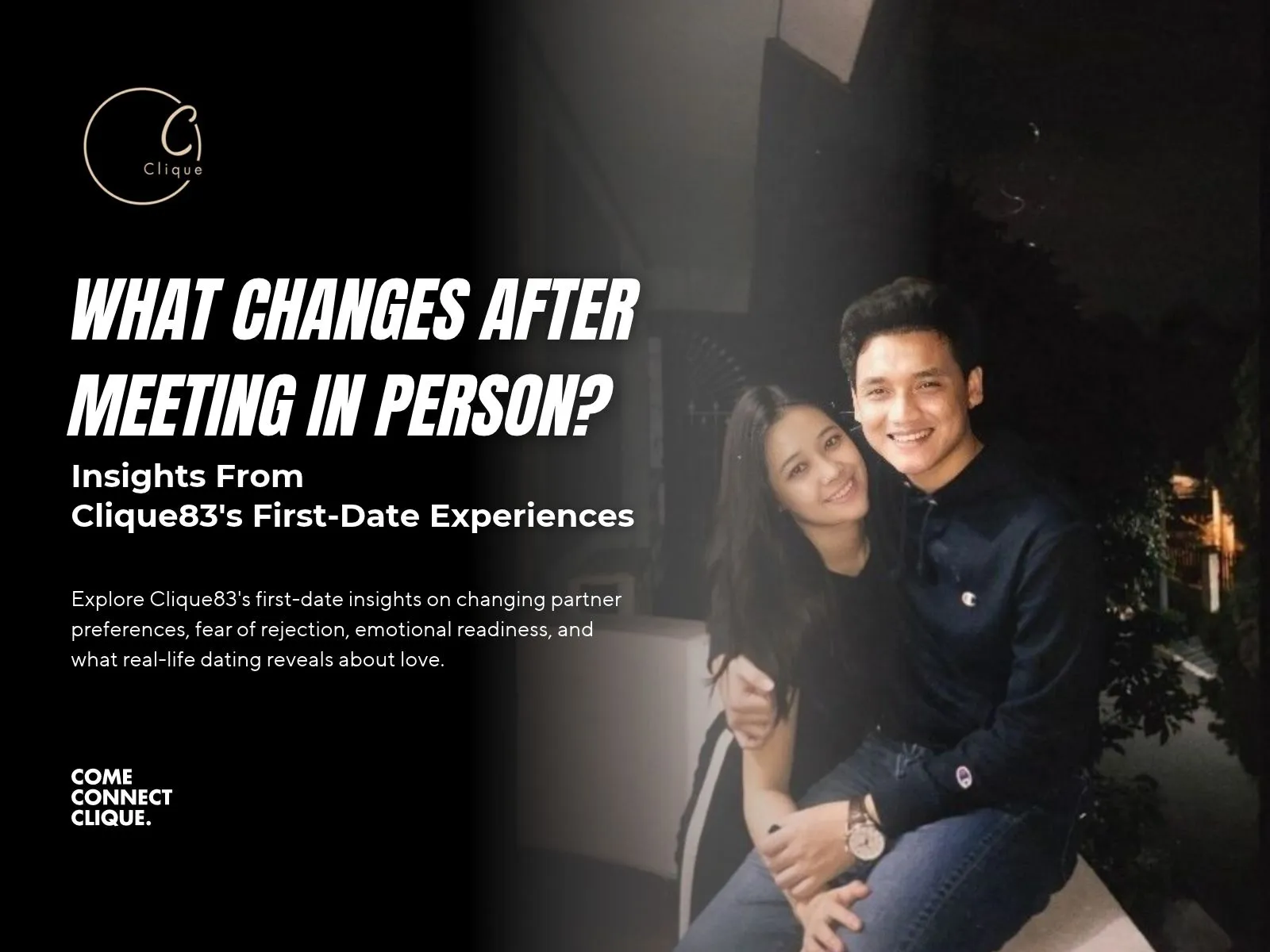
A first date can change how someone sees a potential partner. Sometimes, it changes how they see themselves. At Clique83, our members' experiences have revealed some surprising emotional differences between what people expect before meeting and what they discover afterwards. Behind an awkward conversation, an unexpected attraction or a decision to stop dating, there can be deeper questions about self-worth, relationship expectations and readiness for love.
Drawing on the stories our members have shared, we explore what happens psychologically when an introduction becomes a real-life experience, and what these discoveries have taught us about matchmaking.
What We Have Learned From Our Members' First-Date Experiences
Our members' stories reveal that first-date experiences are rarely defined by attraction alone. The most revealing moments sometimes happen after the meeting, when people reflect on their feelings and reconsider what they initially believed about themselves or the person they met.
1. Fear of rejection can make two interested people believe their feelings are one-sided
Two people can genuinely like each other and still leave a first date believing their feelings are not mutual.
In our Coffee Date story about a first-date misunderstanding, M had not dated for two years before meeting Q. Although she was interested in him, nervousness made her avoid eye contact and respond briefly.
When our team checked in afterwards, M admitted that she wanted to know Q better but worried she had not appeared attractive enough. Meanwhile, Q interpreted her reserved behaviour as rejection and decided to give her space.
What struck us was how both people became more concerned about being unwanted than about expressing what they actually felt. M questioned her own attractiveness, while Q took her silence as a sign to withdraw. Their reactions created distance despite their mutual interest.
Our post-date conversations helped clarify the misunderstanding and gave them an opportunity to meet again.
We have learned that emotional self-protection sometimes makes genuine interest difficult to recognise. Similar gaps between what people believe and what they experience also appear in their expectations of an ideal partner.
2. Meeting someone can reveal that an ideal partner preference was actually a deeper emotional need
Meeting someone in person can help people realise what they truly value in a partner, even when it differs from their original preferences.
In our dating expert's reflections on relationships with younger men, we shared stories of women who initially avoided dating younger men.
One client, L. Vien, associated an older partner with emotional security. Yet her relationship with a younger man changed that belief as she experienced his maturity through how he listened and supported her.
Her experience revealed something important to us: the age preference had been connected to the feeling of security she wanted, rather than age alone.
We see similar distinctions worth exploring when members consider their Match Letters. Someone may initially admire a partner's professional ambition, then realise through conversation that having more time together is personally important. Such changes are possibilities we want to understand, rather than outcomes we assume for every member.
Our introductions reflect the preferences members share, while meeting someone offers a chance to discover what those preferences mean in everyday life.
Sometimes, that reflection goes even deeper, prompting a person to reconsider why they wanted a relationship in the first place.
3. A first date can expose the difference between wanting love and feeling expected to be in a relationship
The decision to start dating can be influenced by personal desires as well as expectations from family and society.
Someone may feel content with their career and independence, yet experience growing pressure as friends marry and family conversations repeatedly turn towards settling down.
A first date brings the idea of having a partner into a more personal setting. Suddenly, a relationship means making time for another person and becoming emotionally involved in their life.
That experience may help someone recognise that they are genuinely excited about companionship. Others may realise that the desire to stop being single has been stronger than their readiness to build a relationship.
4. A meaningful conversation can change someone's belief about being ready or worthy of love
Hieu and Trang's Coffee Date story about building a future together reveals how personal expectations can delay someone's willingness to pursue love.
After a difficult relationship, Hieu focused on building his career and believed he needed greater stability before entering another serious relationship.
During their first meeting, he openly shared his ambitions and the parts of his life he was still working on. Trang responded that she valued two people building their future together.
Their conversation helped Hieu reconsider a belief he had carried for some time: that he needed to become a more accomplished version of himself before being ready for love.
What we find meaningful is how easily the desire to become a responsible partner can develop into the belief that one's current self is insufficient.
Hieu's ambitions remained important, but meeting Trang helped him see that a relationship could also be built while two people were still growing individually.
Our experience reminds us that readiness is deeply personal. Even after someone begins feeling ready, however, a promising first date can still leave them uncertain about taking the next step.
5. Feeling hesitant after a good date can reveal conflicting emotional needs
A positive first date does not always lead to an immediate decision to meet again.
Our Coffee Date members' first-date feedback includes a reflection from a 28-year-old member in Ho Chi Minh City, who shared that the meeting went well but that everything still needed more time.
We find this hesitation worth understanding because enjoying someone's company and feeling ready to pursue a relationship are different emotional experiences.
Someone may appreciate the connection while feeling cautious about becoming vulnerable after a difficult past relationship. Another person may enjoy the date but realise that their current priorities leave little room for a romantic commitment.
There is also the simple possibility that the interaction was pleasant without creating romantic interest.
These experiences can produce similar post-date responses while reflecting very different intentions.
At Clique83, we believe listening to what members voluntarily share helps us respect those differences. A request for more time deserves patience, just as a decision to stop deserves respect.
Hesitation can also reflect something more immediate: how comfortable someone felt during the first meeting.
6. First-date awkwardness can hide how someone behaves when they feel comfortable
A quiet first date can reveal as much about someone's nervousness as their personality.
In our Coffee Date story about an underwhelming first date and an unexpected second meeting, L met a man who shared her interest in hiking. He seemed gentle but rarely initiated conversation, leaving her uncertain about their compatibility.
When he expressed interest in meeting again, L agreed. Their second conversation was noticeably different: he became more expressive and comfortable. She later learned that their first meeting had been his first experience getting to know someone without messaging beforehand.
We see an important distinction between how someone behaves under the pressure of making a first impression and how they connect once that pressure eases.
A reserved conversation may reflect unfamiliarity with the situation, while genuine communication differences remain equally possible.
L's experience shows why the context behind a first impression deserves consideration. Their second meeting allowed her to discover qualities that had been difficult to observe initially.
Other qualities, particularly thoughtfulness and emotional attentiveness, sometimes become visible only through repeated interactions.
7. Attraction can grow when attention becomes visible through everyday actions
Romantic attraction sometimes develops as people notice how someone treats them over time.
In a Thử Vị Yêu love story about attraction developing after several meetings, one woman described feeling little attraction towards a man she had spent several hours with at the event.
However, subsequent group gatherings changed her impression. She discovered his humour and began noticing small acts of consideration.
He made space for her when she arrived late to dinner. On another occasion, he remembered her craving for Hanoi-style cốm xào and offered to bring some back from a trip.
Their relationship eventually developed beyond friendship.
What stands out to us is that attraction grew as she experienced the attention behind his actions. Qualities such as thoughtfulness became personally meaningful when she saw how he expressed them towards her.
Our experience has shown that an initial impression captures only part of a person's character. Repeated interactions sometimes reveal qualities that gradually change how two people feel about each other.
The environment in which people first communicate can influence those impressions too, as another Clique83 story illustrates.
8. Meeting in person can challenge assumptions formed through online communication
Sometimes, two people assume they are incompatible because their online conversations never develop naturally.
Linh and Minh's story of reconnecting after an unsuccessful dating-app match offers an interesting example.
They had previously matched on another dating app, but their conversations gradually faded as work interrupted their communication. Both assumed the connection lacked potential.
Later, Coffee Date introduced them again. Their Match Letter provided more context about each other's lives and values, encouraging them to meet.
The face-to-face conversation felt different. They recognised each other from the previous app and eventually began a relationship.
We find their experience revealing because a disappointing online interaction can reflect communication habits and circumstances rather than a complete picture of compatibility.
Delayed messages can be interpreted as disinterest, while a real conversation allows people to experience each other's attention and responses more directly.
For us, their story captures an important part of Clique83's philosophy: our matchmaking process helps create a thoughtful introduction, while meeting in person gives two people the opportunity to discover what their connection feels like in real life.
What These Experiences Have Taught Us About Building Clique83
Our first-date stories have influenced how we think about the relationship between introductions, emotional expectations and real-life experiences.
As Clique83's co-founders, Han Lam and Thuy Doanova bring complementary perspectives to this work. Han focuses on the systems and product experience that support meaningful introductions, while Thuy places particular emphasis on user psychology and understanding the emotional concerns people bring into dating.
Together, these perspectives reflect a belief we have developed through our work: understanding someone's preferences is an important starting point, while understanding how they experience a connection requires attention to the human side of dating.
The person behind a profile deserves more attention than the criteria alone
Our matchmaking platform centres on introductions through an AI-powered matchmaking app and premium human-led matchmaking. Events and mixers provide additional opportunities for people to meet.
These experiences have different processes, but they contribute to our understanding of how initial expectations can develop once two people interact.
In our AI-powered Coffee Date experience, members share information about themselves and receive one introduction at a time. The Match Letter presents the person behind the introduction, including aspects of their lifestyle, personality and values.
We see this as a starting point for personal consideration.
Our premium matchmaking experiences also demonstrate why understanding the motivation behind a preference can be meaningful. A preference for an older partner, for example, may invite a deeper conversation about the importance someone places on maturity.
We respect the standards members bring into matchmaking while recognising that personal experiences may help them refine those standards over time.
Post-date reflections can reveal what a successful introduction alone cannot
A match tells us that an introduction has been made. A completed date confirms that two people have met.
The experience between those two moments, and what each person feels afterwards, contains another layer of information.
The story of M and Q demonstrates how much can be missed when emotional responses are inferred solely from outward behaviour.
The stories of L and Hieu reveal different kinds of change: one related to first impressions, the other to personal readiness.
These accounts reinforce the value of listening to what members voluntarily share about their experiences.
They also remind us to distinguish emotional outcomes carefully. Enjoying a date, exchanging contact information and beginning a relationship represent different stages of connection.
What Changes After the First Date? Our Perspective
The changes that follow a first date often extend beyond a revised impression of another person.
Our members' experiences reveal how a real meeting can bring personal concerns into focus. Fear of rejection may influence how someone expresses interest. A long-held partner preference may carry an underlying emotional expectation. A conversation may challenge the belief that personal success must come before romantic commitment.
Other questions remain worth exploring, particularly how social expectations influence the decision to start dating and why some people feel hesitant even after a positive encounter. Our existing published stories provide reasons to examine these questions, while further member feedback would be needed to establish their prevalence within our community.
At Clique83, we have learned to value the differences between these experiences.
A first date can bring clarity about another person, but it can also reveal what someone believes about love, personal worth and the kind of relationship they genuinely want.
That understanding continues to inform the way we build Clique83's matchmaking experiences, where technology supports introductions and real-life encounters give people the opportunity to discover what a connection means to them.
The future of dating is offline because relationships ultimately develop between people, through their own experiences and choices.
Read more: From Offline Dating Events to an Matchmaking App: The Clique83 Story