
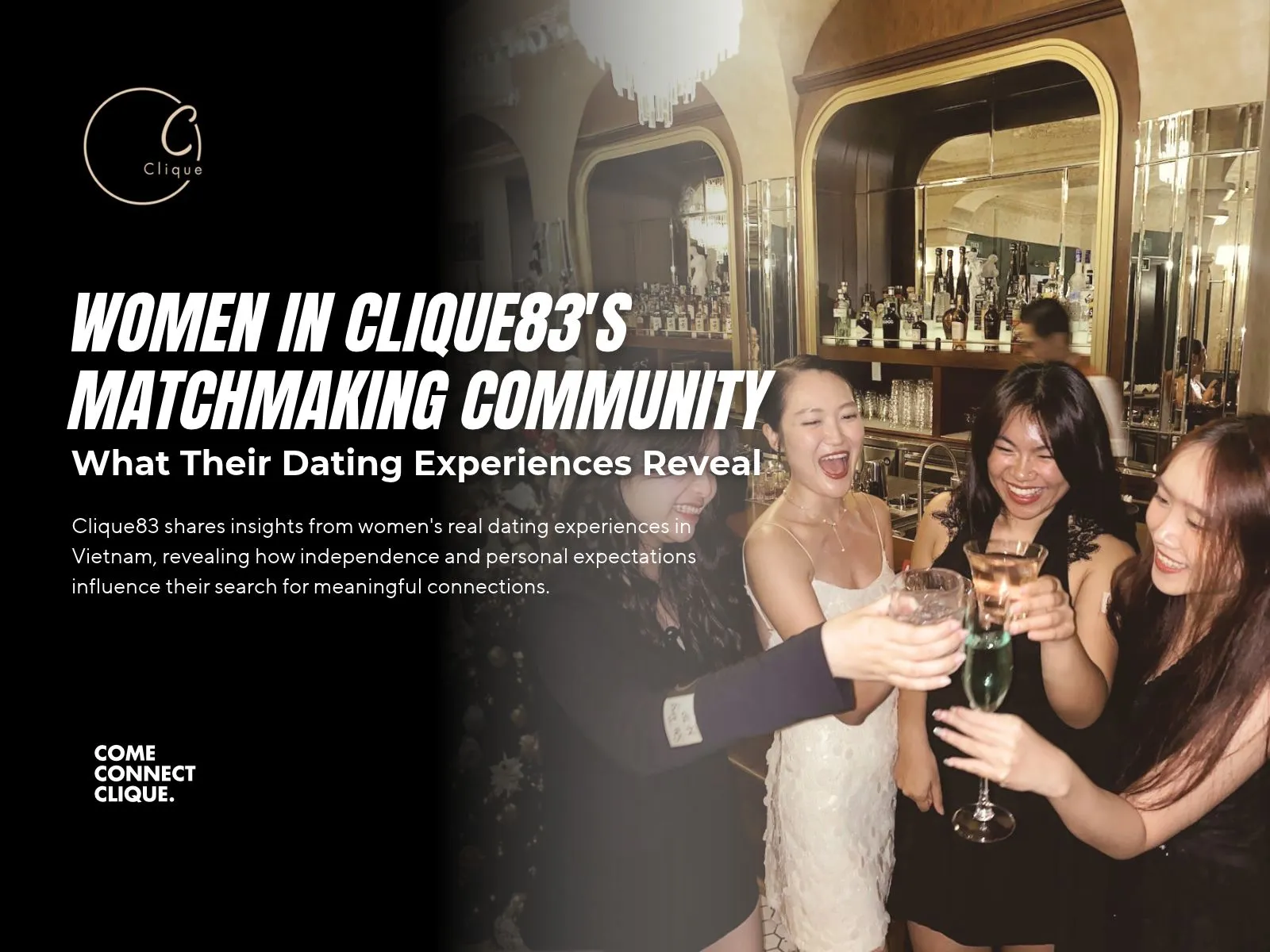
As of September 2026, women represented 75% of Clique83's reported matchmaking app membership. Behind that figure are women with established careers, personal ambitions and their own expectations of love. Some are ready for a serious relationship. Others are still working out what commitment means to them.
As a matchmaking platform founded by two Vietnamese women, we understand that being single tells only a small part of someone's story. The experiences shared within our community have given us a closer look at the emotions, expectations and personal decisions that influence how women approach relationships.
We have also learned something important: a woman's desire for connection is closely tied to the life she has built, the experiences she carries and the future she wants for herself.
Here is what our community stories, founder experiences and wider research reveal about women navigating modern dating in Vietnam.
Being Single Is Becoming a More Personal Choice
Vietnamese women are spending more of their adult lives unmarried. According to Vietnam's National Statistics Office, 31.9% of women aged 25–29 and 13.1% of those aged 30–34 had never married in 2024.
We see these figures as part of a changing social context, although marital status alone cannot explain why someone remains single.
Some women are genuinely enjoying life on their own. Others want a partner but have yet to meet someone with whom they see a future. A number are prioritizing their careers or recovering from previous relationships.
We believe the conversation about single women needs to move beyond when they will get married and toward what they actually want from a relationship.
Our co-founders, Han Lam and Thuy Doanova, have challenged the stigma around singlehood since Clique83's early days. In a November 2024 interview with VnExpress, they explained that their approach to dating centered on helping people meet and discover meaningful connections, rather than treating marriage as an obligation to fulfil by a certain age.
That philosophy remains central to our matchmaking platform.
We meet people at different stages of their personal lives. Their relationship status tells us little about the experiences that brought them there or what kind of connection they are hoping to find.
Self-love is influencing women's relationship expectations
Building a fulfilling life increasingly involves decisions women make for themselves: developing professional skills, becoming financially independent and discovering what brings them personal satisfaction.
Those experiences also influence their expectations of a partner.
A woman who has spent years building her independence has good reasons to value someone who respects her ambitions. She may want emotional companionship while maintaining the freedom to pursue her own interests.
We find the distinction between self-worth and perfectionism particularly important in understanding dating expectations.
Knowing one's value helps clarify which aspects of a relationship deserve attention. Expecting a partner to satisfy every preference, however, risks overlooking the qualities that become visible only through real interaction.
We have seen how personal expectations develop through real-life meetings.
In Hieu and Trang's Coffee Date story, Hieu believed he needed greater career stability before entering a serious relationship. Trang expressed a different view: she appreciated the possibility of two people building their future together.
Her perspective challenged the idea that love must wait until every aspect of life feels complete.
We see an important lesson in their experience. Personal growth deserves a place within a relationship. Two people can support each other's ambitions while continuing to develop individually.
So, a meaningful partner respects who someone has already become and takes an interest in who they are still becoming.
Women Are Reconsidering What Marriage Means to Them
Marriage remains an important aspiration for many women in our community and across Vietnam. Their expectations, however, deserve more attention than the age at which they hope to marry.
One experience from Clique83's early community illustrates the distinction.
In our November 2024 VnExpress coverage, Ngọc Diệp, a 30-year-old spa owner, described how her parents continued encouraging her to marry and have children before 35, despite her professional achievements.
Diệp had a different perspective. She wanted a relationship built on genuine affection and shared values, with mutual understanding between partners.
Her experience reflects a tension we believe deserves greater recognition.
A woman can value marriage deeply while rejecting the expectation that it must happen according to someone else's timeline.
The quality of married life is becoming part of the decision
We see marriage as a decision that extends well beyond finding someone attractive or reaching a certain age.
Daily responsibilities become part of the relationship once two people begin building a shared life. Their expectations around careers and personal freedom also need to coexist.
Research on gender norms in Vietnam helps explain why these considerations are significant.
The Social Norms, Attitudes and Practices Survey (SNAPS) 2024, published in 2026 by Investing in Women, found that support for gender equality coexists with persistent expectations about women's domestic and caregiving responsibilities.
The gap between attitudes and household practices raises an important question about relationship compatibility.
Two people might agree that they value equality. Their relationship will eventually depend on how that belief appears in everyday decisions.
A woman who watched her mother manage most household responsibilities may pay particular attention to a potential partner's willingness to contribute. Someone who has experienced a highly supportive family environment may hope to recreate that sense of partnership.
Both examples illustrate why we view compatibility as something deeper than similar interests.
The future a couple imagines together needs to make sense for both people, including the responsibilities that come with it.
Our matchmaking approach respects the importance of understanding individual values before two people decide to meet. A promising introduction offers a starting point for discovering how those values translate into a relationship.
The Marriages Women Grew Up With Can Influence the Love They Seek
We believe a woman's relationship expectations deserve to be understood within the context of her personal experiences.
Some of those experiences begin in childhood.
A daughter may grow up watching her mother care for the household while putting her own ambitions aside. She may remember the emotional distance between her parents or the arguments that made home feel uncomfortable.
Another woman might remember parents who consistently supported each other, giving her a positive model of partnership.
These experiences create different expectations about intimacy and commitment.
The fear of repeating an unhappy marriage
One difficult question deserves particular attention: What happens when a woman wants to fall in love but fears living through the same marriage she witnessed growing up?
A 2025 Vietnamese study involving 199 adults aged 20–35 identified negative marital experiences within the family or wider society as one of the factors associated with reluctance to marry.
The study provides context for a concern that is deeply personal and often difficult to express.
Some women worry about losing their independence after marriage. Others fear unequal responsibilities or repeating unhealthy patterns of communication.
We recognize that these concerns have different meanings depending on individual experience.
A woman who witnessed an unhappy marriage can still believe in love. She may simply have a clearer understanding of what she wants to avoid in her own relationship.
We also see a distinction between being afraid of marriage itself and being cautious about the kind of marriage one might enter.
The second concern deserves a different conversation. It involves exploring what emotional security and a supportive partnership mean to that individual.
A woman's past can help explain her expectations without determining the future of her relationships.
We do not assume that every woman with a difficult family history fears commitment. Equally, we believe those experiences deserve sensitivity when someone chooses to share them.
Our work in matchmaking reinforces the importance of allowing people to explain their relationship expectations in their own words. Personal history provides context; it never tells the whole story.
Busy Careers Leave Less Room for Meeting Someone New
Clique83 began with a problem our founders understood personally.
Han Lam and Thuy Doanova had built demanding professional lives and experienced the difficulty of creating meaningful connections beyond their familiar circles.
In their 2024 VnExpress interview, Han described how professional responsibilities limited her opportunities to date. Even when she met someone interesting, she often had little way of knowing whether that person was single or interested in pursuing a relationship. Thuy, drawing on her experience working in technology in Europe, also spoke about the desire for genuine human connection.
Those experiences contributed to the founding of Clique83.
We understood that wanting a relationship and having realistic opportunities to meet someone were two different things.
Having time for a date is different from having time to find one
Working professionals often have the ability to set aside an evening for a promising introduction.
The difficult part is getting to that introduction.
Finding new people outside an established social circle takes effort. So does figuring out mutual interest and sustaining a conversation while managing professional responsibilities.
Over time, repeated introductions that lead nowhere can reduce someone's enthusiasm for trying again.
Our story of Linh and Minh illustrates how professional routines can interrupt a connection before it develops. They had matched through another dating app. Both were busy with work, and their messages became increasingly irregular. Eventually, they concluded that the connection lacked potential.
Later, Coffee Date introduced them again.
With a personalized introduction offering more context about each other's lives, they became curious enough to meet. Their in-person conversations gave them a different understanding of one another, and they eventually entered a relationship.
Their story reveals something we find important in modern matchmaking: A conversation that loses momentum does not mean two people lack romantic potential. Sometimes the opportunity to understand each other has simply been too limited.
People can live close together without ever connecting
Another story from our community makes the problem even clearer.
M, an office worker living in Thu Duc, traveled nearly 20 kilometres to attend a Clique83 dating event in District 1.
She met someone she wanted to know better, and they eventually became a couple.
Only later did they discover that they had been working in the same office building, just two floors apart.
Their unexpected meeting through Clique83 demonstrates how ordinary routines can keep potential partners from becoming acquainted.
Being physically close to someone creates the possibility of meeting. It takes an actual opportunity for a relationship to begin.
We see this as one of the central problems real-life matchmaking helps address. Our role is to make meaningful introductions possible within the lives people are already living.
A Full Social Life Does Not Always Mean Feeling Connected
We understand another experience that often receives less attention in conversations about successful, independent women.
A woman may enjoy her career and maintain close friendships, yet still feel the absence of romantic companionship.
Her days can be full of conversations with colleagues and enjoyable social activities. Returning home to an empty apartment may bring a very different feeling.
Perhaps she wants someone to share an ordinary evening with. Perhaps she misses having a person who understands the quieter parts of her life.
That longing is distinct from general social isolation.
The World Health Organization explains loneliness as a perceived gap between the social relationships people have and those they want. Being surrounded by others does not automatically remove that feeling.
We believe the distinction is particularly relevant to adult dating.
Someone can be happy with her independence and still wish to share part of her life with a partner.
Romantic companionship also has different meanings.
One woman may value having someone to talk to after a difficult day. Another may long for the familiarity of building daily routines together.
Others find emotional fulfilment through friendships and family relationships and are content without a romantic partner.
We respect each of these experiences. And Clique83 was founded on the belief that people who want a connection deserve more opportunities to experience one in real life.
How Women's Dating Expectations Differ Across Life Stages
Women's relationship expectations evolve with their experiences and personal priorities. At Clique83, we recognize that age provides useful context, while each woman's life journey offers a deeper understanding of what she seeks in a partner.
Ages 25–29: Exploring Love While Building Their Future
Women in their late twenties are often developing their careers and discovering what they value in life. Many remain open to serious relationships while giving themselves time to understand what lasting compatibility means. In this age group, being ready for love doesn't necessarily mean being ready for marriage.
Ages 30–35: Seeking a Partner Who Respects Their Independence
With more established careers and personal priorities, women in their early thirties may place greater emphasis on how a relationship fits the life they have built. Our experience with women like Ngọc Diệp highlights an important distinction: the desire for marriage can coexist with the determination to choose its timing and terms independently, despite family expectations.
Ages 36 and Above: Greater Clarity, Yet More Caution
With more life and relationship experience, women over 35 may have a clearer understanding of what they value in a partner. Some have experienced heartbreak or difficult relationships, making emotional security and mutual understanding especially important. At Clique83, we recognize that knowing what someone wants from love does not always make it easier to trust again or welcome a new person into their life.
How Women's Dating Experiences Are Shaping the Way We Build Clique83
Clique83 was founded in 2024 by Han Lam and Thuy Doanova, who personally understood the difficulty of finding meaningful connections while building demanding careers. As our matchmaking community has grown, the experiences women have shared with us have deepened our understanding of what people need before and after meeting someone new.
Our published Success Stories reveal how much can remain unseen during a first date. In M and Q's experience, nervousness was mistaken for a lack of interest until our team's follow-up helped clarify their feelings. Another member, L, discovered a different side of her match during their second meeting. These experiences have taught us to look beyond first impressions and pay closer attention to how members describe their feelings after meeting.
We also recognize the importance of personal agency in matchmaking. When Tran initiated an honest conversation about the religious differences affecting her relationship with Vu, she demonstrated why both people deserve a voice in decisions about their future. Our role is to support informed choices while respecting each person's willingness to continue a connection.
These insights continue to inform how we develop Clique83. In Coffee Date, personalized Match Letters provide context before a meeting, while mutual interest determines whether an introduction progresses to a real-life date. Our post-date support also highlights the value of listening to members' experiences, particularly when initial impressions leave room for misunderstanding.
As we develop our AI-powered matchmaking app and premium human-led matchmaking, we want to deepen our understanding of the personal expectations behind each introduction. Better context before meeting and thoughtful support afterward remain important priorities, alongside protecting members' freedom to make their own relationship decisions.
Our greatest opportunity comes from learning what happens beyond the match. Every experience shared with us offers a chance to understand how people approach connection, and to keep building a matchmaking platform that brings technology and human understanding closer together.
Read more: The Matchmaking App With More Women Than Men: Why Clique83’s Ratio Matters
Every Woman Brings Her Own Story Into Love
Our experience at Clique83 has taught us that a woman's readiness for love is shaped by more than her relationship status or age. Her past experiences, personal values and expectations influence how she approaches connection and what makes her feel comfortable moving forward.
We believe meaningful matchmaking begins with understanding those individual motivations, while giving people room to discover feelings that a profile alone cannot reveal. As Clique83 continues to grow, our commitment remains the same: to create opportunities for real-life connections where women feel understood, respected and free to choose how their relationships develop.
Read more: From Offline Dating Events to an Matchmaking App: The Clique83 Story
References
General Statistics Office of Vietnam. (2024). Key findings of the 2024 Intercensal Population and Housing Survey. Statistical Publishing House.
Investing in Women. (2026, March 4). SNAPS 2024: Understanding gender norms across Indonesia, Malaysia, the Philippines & Vietnam.
Milieu. (2026, June 17). Time is ticking: SE Asia's journey of hitting 35 and looking for love.
Nguyễn Thị Thanh Vân, Nguyễn Mai Trúc, Đặng Thị Hồng Hải, & Nguyễn Thị Đông Ân. (2025). Các yếu tố ảnh hưởng đến tâm lý ngại kết hôn ở người trẻ Việt Nam. Tạp chí Tâm lý – Giáo dục.
Phan Dương. (2024, November 25). Buổi gặp gỡ của những người chán ứng dụng hẹn hò. VnExpress.
World Health Organization. (2025, June 30). Social connection.